

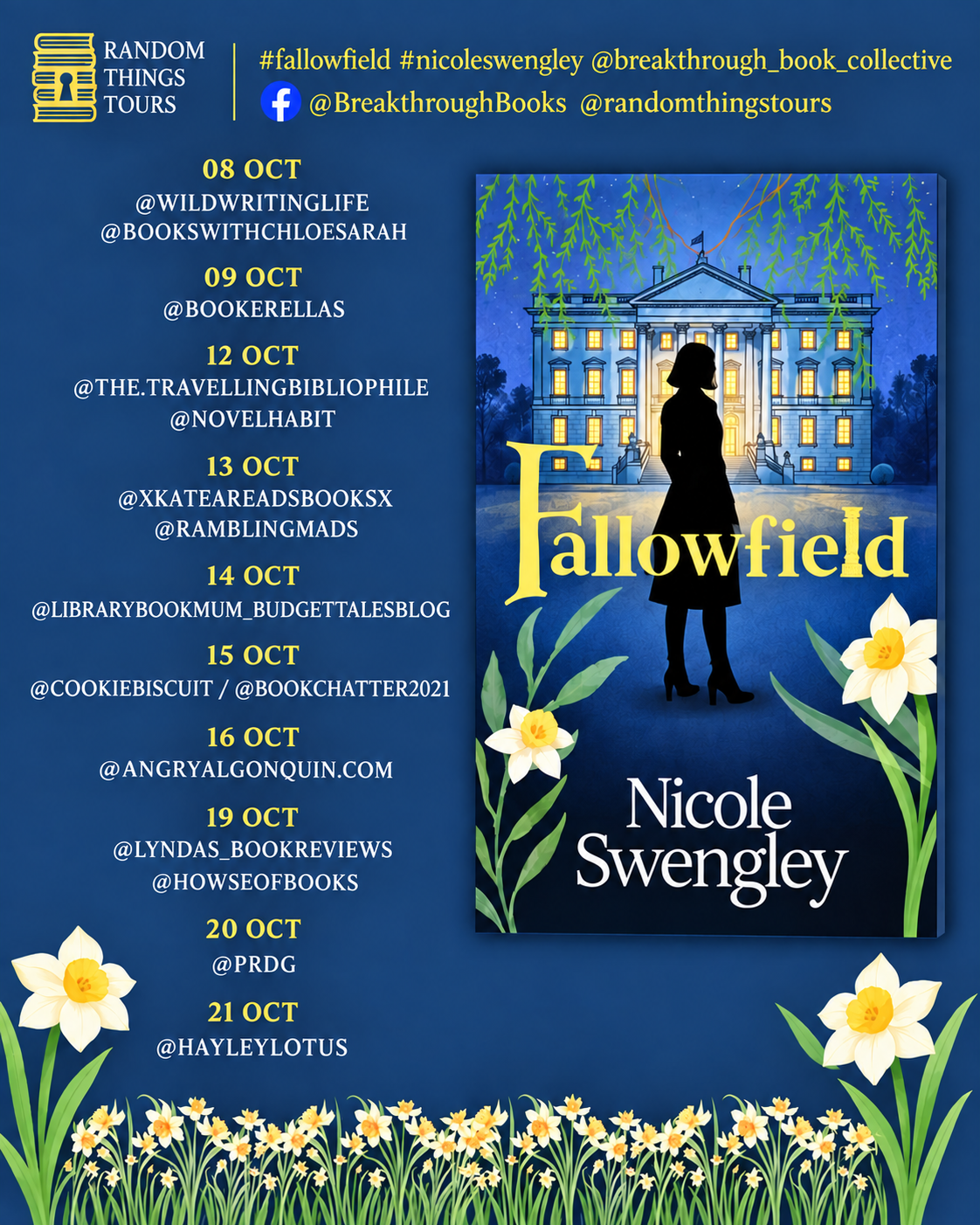
Many thanks to Anne Cater of Random Things Tours and Breakthrough Books for the advance copy of "Fallowfield" for review. Since the ARC included the final cover and it's such a striking image, I would like to call out the designer, Ivy Ngeow. After finishing the book, I realized how finely the cover captures both the mood and themes of the story.

I'm a big fan of murder mysteries set in the world of art and artists. Two of my favorites are "Silence Observed" by Michael Innes and "Artists in Crime" by Ngaio Marsh. In "Fallowfield", a woman is trying to tell the truth from the lies about her father's past. The book benefits from a "Rashomon"-like narrative; with conflicting stories that only have one thing in common: The main events take place at Fallowfield Hall, an art college housed in a Georgian manor house in the village of Fallowfield.
In the 1970's, Fallowfield college was unconventional even for its time. It's set on the grounds of a posh English estate sheltered from the outside world. The property includes a beautiful lake with an ornamental bridge. There's a building called the "pheasantry" which I thought was going to be a kind of storage facility, but wasn't. Every year at end of term there was an elegant summer ball.
In contrast to this peaceful world is the exciting, turbulent, and competitive school. Some of the artists (tutors and students) will go to any length to stand out, get noticed, become famous. This dynamic gives rise to some unusual, possibly dangerous, artistic practices. The college's combative environment is a jarring contrast to the bucolic surroundings.
The book opens with journalist Rowan Woodhouse, writing in her diary on New Year's Eve in 2025. This time of year is one of reflection and remembrance for Rowan. Ten years ago, she discovered some very disturbing things about her parents, both of whom attended Fallowfield art college. The experience left Rowan "stuck and very damaged", but the implication is that this is no longer the case.
Rowan's father was famed artist Nick Woodhouse. When he met Rowan's mother Annie at Fallowfield, he was a tutor and she was a student. They fell in love and dated secretly until they got married. Annie died young, and Nick never quite recovered. Weighed down by grief, he tried to be a good father, but Rowan knew she would always come in second to his profound devotion to her mother.
In 2015, Rowan was a journalist living in London. She receives a call from Gita Gopal, head administrator of Fallowfield art college (which is now located in Sussex.) In 1977, the original Fallowfield closed due to a series of scandals. It didn't re-open for years. The original Fallowfield Hall, long-unoccupied, has been turned into an upscale resort by a private investor.
Gopal is organizing a "Gala Night" at the newly refurbished Hall to mark Fallowfield's half century anniversary. Since Nick Woodhouse had been a student and tutor there in the 1970's, Gopal asks Rowan for memorabilia for inclusion in an exhibition. Rowan agrees to help, and starts by digging out a suitcase she hasn't opened since her father's death.
What she finds piques her interest but also sets off some alarm bells. Rowan finds a news clipping from 1976, about a Fallowfield student who disappeared from the local pub one night and was never found. Rowan wonders why her father kept this clipping; was she a student of his and if so, was he involved in some way? She also finds his notebooks from those days, containing hundreds of sketches of her mother, Fallowfield, and fellow students. Rowan sees her father's love for Fallowfield and Annie in every sketch. It seems odd that he and Annie abandoned the school and moved to London immediately after she graduated.
Deciding that the notebooks are too precious to lend to the exhibition, she returns them to the suitcase. Another clipping drops out, headlined "SCHOOL FOR SCANDAL CLOSES".
In the article, the chairman of the group who funded the college is quoted as saying that "Fallowfield's reputation had been severely damaged and therefore, its future was unsustainable". He had good reason to think so. First, there was what was determined at the time to be the "untimely death" of the college bursar, Alan Carter, in 1975. The next May, a second-year student disappeared (the first clipping that Rowan found) followed one month later by the death of a "tutor's girlfriend", a young woman named Zizi (the second clipping).
Rowan hopes that the "tutor" mentioned in the article was not Nick, since he was already involved with her mother by then. She realizes how little she really knows about her parents' years at Fallowfield. Fortuitously, Gita Gopal calls her with a request to interview Fallowfield alumni and retired tutors and write something for the anniversary booklet (pro bono of course). Thinking fast, Rowan agrees to "do the 70's" if other writers will do other decades. This gives her a perfect excuse to find out what she already wants to know.
Gopal sends her a list of names, and at first, no one is interested in talking about the old days at Fallowfield Hall. The first person she calls is Fallowfield alumna Eve Lonsdale, now living in New York. Eve's husband answers the phone, refuses her request to talk to Eve, barks out "don't call us again" and hangs up. Her next call to art gallery owner Patrick Davenport is slightly more promising. He's not too keen on reminiscing about his student days but always keen for potential publicity, invites Rowan to his gallery.
Rowan meets Patrick and he gives her a tour. Eventually, she asks him if Nick Woodhouse had been one of his tutors. Patrick was a student of his and is astonished that she's Nick's daughter. Despite what he told her on their call, he begins to reminisce about his time at Fallowfield. He recalls the splendid surroundings, the students "living in a wonderful bubble which cushioned us from the painful realities of everyday life...". Rowan brings up the story about the student that disappeared in May of 1976. He vaguely remembers hearing that a student vanished one night on her way back from the pub, but that's it.
Rowan also finds it interesting that Patrick was on the committee that organized the Fallowfield summer ball that year. It was the last event the original Fallowfield school ever had. If Rowan can find out what really happened that night, she believes it will give her some of the answers she's looking for.
Patrick recommends that Rowan talk to Maksym Kaminski, who was the next name on her list. He gives her some background on Maksym. Patrick remembers Maksym, a tutor at the same time as her father, as egotistical and eccentric. He and her father were very competitive, always trying to outdo the other. According to Patrick, Maksym was a malicious person; spiteful enough to spread a rumor at the school that Nick was cheating on Annie.
Rowan makes an appointment with Maksym, now a celebrated creator of sculptural furniture and public artworks. She turns up at this studio and he matches Patrick's description, sarcastic and condescending. He's not immune to abject flattery though, so Rowan lays it on thick to pry information out of him. She inquires why one of her father's paintings is hanging on the wall, since Patrick told her he and Nick were bitter rivals at school. Maksym snidely remarks that Nick gave it to him for "services rendered", whatever that means.
Nick's painting is an example of a style of artwork called "Good Girl" art.
covers would increase sales of genre fiction."
As a teenager, Rowan thought that her father's "Good Girl" paintings were "degrading and trashy". He changed her opinion by showing her how his work differed from the lurid, exploitative covers. She now appreciates his aesthetic interpretations of "Good Girl" art. There's a Fallowfield connection too: One of its deans, Frank Sixsmith, was one of the original "Good Girl" cover artists in the late 1940's. The "Good Girl" art movement is well-integrated into the book's plot; Swengley provides additional background in the Acknowledgments section.
Maksym leads Rowan to Jack Drinkwater, a visiting lecturer of cultural history at Fallowfield. He tells her a story about a scam he and Nick pulled when they were tutors. Rowan, who didn't think her father would ever compromise his art, is unsettled. She decides to try calling Eve Lonsdale again and this time, Eve picks up instead of her obstructive husband. Eve's happy to talk about Fallowfield and she helps Rowan to resolve at least one mystery. But there's more investigating to be done, and Rowan works her way down the list. One former student is now a wealthy art collector. Another student, the owner of a boutique hotel chain, is the man who bought Fallowfield to make it a resort. The memories collide and contradict, only obscuring the truth.
The determined Rowan presses on, coming to some very disturbing conclusions along the way. Her search culminates at the Gala Night party at Fallowfield Hall, now a luxury resort. All the people on Rowan's list are back at the place where it happened. It's time for Rowan to discover the truth amidst the lies.
In "Fallowfield", Nicole Swengley juxtaposes the joy and fulfillment of the artistic life against a backdrop of intense emotion, towering egos, and fierce competition. Her incorporation of the history of "Good Girl" art into a story of deception and blackmail was a compelling aspect of the book. It was great fun to follow Rowan on her quest, and I was agreeably surprised by the conclusion. As a fan of art-related mysteries, I found "Fallowfield" a compelling read.
And when you finish the book, take a second look at that cover...
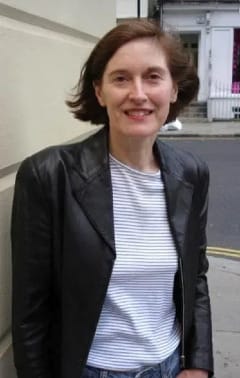
Nicole Swengley is a highly-regarded and experienced journalist who has written about art and design for titles such as The Times, Financial Times, Daily Telegraph, London Evening Standard, Wall Street Journal and many others. A past student of the Faber Academy, Nicole has written non-fiction books for Collins and Adlard Coles and has had several short stories published in magazines and anthologies. Her debut novel, The Portrait Girl, was published by Breakthrough Books in 2024. Fallowfield is her second full-length work of fiction.
Please buy/order "Fallowfield" from your local independent bookstore, or go to bookshop.org and order there. They now offer ebooks as well.

For audiobooks, go to libro.fm.